


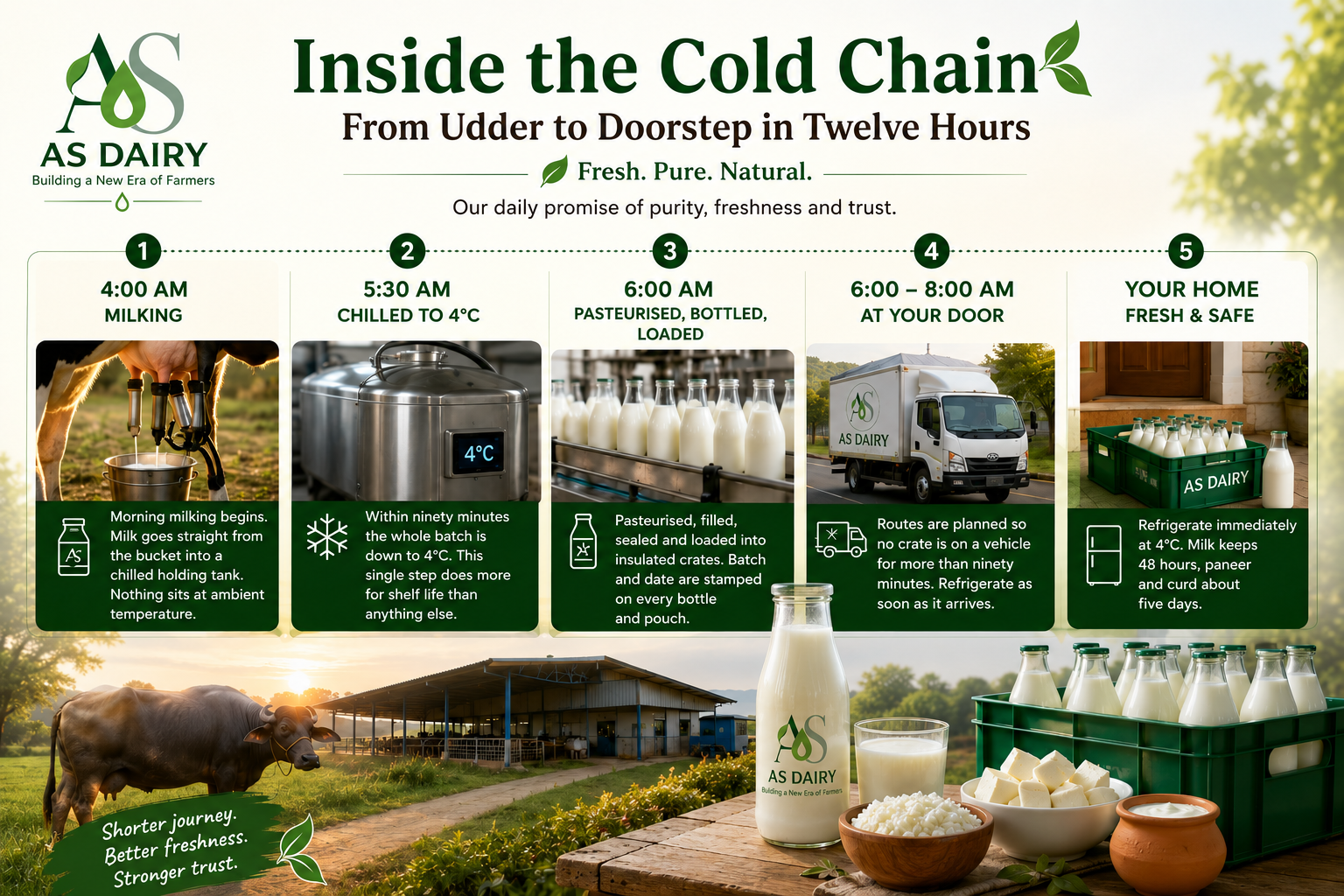
Inside the Cold Chain: From Udder to Doorstep in Twelve Hours
How AS Dairy keeps fresh milk cold, clean, and moving from the farm to your family
Fresh milk without preservatives sounds simple. But keeping it genuinely fresh from the moment it leaves the animal until it reaches your refrigerator is actually a carefully managed process.
For us, freshness isn't just about how the milk tastes. It is about time, temperature, hygiene, handling, and discipline at every step.
Our daily cold-chain routine starts before sunrise and continues until your milk reaches your doorstep.
Here's what happens behind the scenes.
4:00 AM — Morning Milking Begins
While most of the city is still asleep, our dairy routine has already started.
Morning milking begins around 4:00 AM.
Before milking, the animals and milking area are prepared with appropriate hygiene practices. Clean equipment and proper handling are important because once milk leaves the udder, protecting its quality becomes a race against time and temperature.
Freshly collected milk is moved promptly into the chilled holding system.
Why does this matter?
Fresh milk is a nutrient-rich food, which also means it needs careful handling.
The longer milk remains warm, the greater the opportunity for unwanted microbial growth.
That's why our goal is simple:
Milk first. Cooling immediately. No unnecessary waiting.
4:00–5:30 AM — The Race to 4°C
The first major step in our cold chain is rapid cooling.
We aim to bring the milk down to approximately 4°C within 90 minutes of milking.
This is one of the most important temperature-control steps in the entire process.
Rapid chilling helps slow the growth of microorganisms and helps preserve the milk's quality while it moves through the next stages.
Think of it this way:
The faster we cool the milk, the less time it spends in the temperature range where microorganisms can multiply quickly.
For a fresh product, that matters.
5:30 AM — The Batch Is Chilled
Once the batch reaches the required chilled temperature, it remains under controlled conditions while the next stage begins.
Temperature isn't something we check once and forget.
It needs to be managed throughout the journey—from the farm and processing area to packaging, transportation, and finally your refrigerator.
That's what makes a cold chain different from simply putting milk in a refrigerator at the end.
The cold needs to be maintained throughout the journey.
6:00 AM — Pasteurisation & Quality Handling
After chilling, the milk moves into processing.
Where applicable, the milk is pasteurised using controlled temperature and time conditions designed to reduce harmful microorganisms while maintaining the product's quality.
Pasteurisation is an important food-safety step.
It doesn't mean the milk can be left at room temperature afterward.
Once processed, the milk still needs to be handled and stored correctly.
Pasteurisation and refrigeration work together.
6:00 AM — Bottling & Packaging
After processing, the milk is filled into appropriate food-grade packaging.
Our packaging formats can vary by product.
For example:
- A2 milk: packaged in glass bottles
- Everyday milk: packaged in food-grade pouches
- Other dairy products: packed according to their individual requirements
Each batch is identified with relevant date and batch information so that the product can be traced through our system.
Good packaging isn't only about presentation.
It helps protect the product from contamination, leakage, and unnecessary exposure during transportation.
6:00–6:30 AM — Loading for Delivery
Once the fresh dairy products are packed, they are organized according to delivery routes.
Fresh products are placed into insulated crates to help maintain appropriate temperatures during transportation.
Routes are planned carefully because every additional minute in transit matters when you're delivering fresh dairy.
Our objective is to minimize unnecessary travel and waiting time.
Why insulated crates?
A delivery vehicle isn't a refrigerator for every situation.
Insulated containers help reduce temperature fluctuations and provide an additional layer of protection while the products move from our facility to your home.
6:00–8:00 AM — Your Milk Is on the Way
The delivery network begins its morning run.
We plan routes so that fresh dairy products spend as little time as reasonably possible in transit.
Our target is to keep individual delivery journeys short, with routes planned to avoid unnecessary delays.
The result?
Milk that was being handled at the farm just a few hours earlier is already making its way to your breakfast table.
At Your Door — The Cold Chain Comes Home
The final stage is your refrigerator.
Once your order arrives, refrigerate fresh milk immediately.
We recommend keeping fresh milk at approximately 4°C, or according to the storage instructions provided on the product packaging.
Don't leave fresh milk sitting on the kitchen counter while you finish breakfast.
Put it in the refrigerator first.
Then enjoy it.
And remember:
Cold chain + proper storage = better freshness.
Why We Don't Use Preservatives
Fresh milk doesn't need to be made artificially long-lasting for us to call it fresh.
Our approach is based on:
Rapid cooling → controlled processing → hygienic packaging → insulated transport → immediate refrigeration
Instead of trying to make fresh milk sit for weeks, we focus on getting it from the farm to your family quickly.
That means a shorter shelf life—but a product designed around freshness.
What Happens If the Cold Chain Breaks?
Cold-chain management isn't about one perfect temperature reading.
It's about maintaining control throughout the journey.
Potential problems can occur if:
- Milk is left warm for too long
- Refrigeration is interrupted
- Products are exposed to excessive heat
- Packaging is damaged
- Delivery takes significantly longer than planned
- The customer doesn't refrigerate the product after delivery
That's why every stage matters.
A great product at the farm can lose quality if it is poorly handled later.
Freshness is a chain. Every link matters.
A Simple Look at Our Morning
Time | What happens |
4:00 AM | Morning milking begins |
4:00–5:30 AM | Milk is rapidly cooled toward 4°C |
5:30 AM | Chilled batch is held under controlled conditions |
Around 6:00 AM | Pasteurisation, filling and sealing |
6:00 AM onward | Products are batch-marked and loaded into insulated crates |
6:00–8:00 AM | Morning delivery routes |
At your door | Refrigerate immediately |
Twelve Hours? It's Actually Much Faster.
The title says "from udder to doorstep in twelve hours", but the actual fresh-milk journey is much shorter.
The important point isn't simply the number of hours.
It's what happens during those hours.
From early-morning milking to rapid chilling, processing, packaging, loading, transportation, and delivery, we keep asking the same question:
How do we get fresh milk to your family with as little unnecessary time and temperature exposure as possible?
That's the thinking behind our cold chain.
Freshness Is a Process, Not a Claim
When you open a bottle or pouch of AS Dairy milk in the morning, you see the final product.
Behind it is a much longer routine:
Healthy animals → clean milking → rapid cooling → controlled processing → careful packaging → insulated transportation → timely delivery → your refrigerator
Every step has a job.
And when all those steps work together, something simple happens:
Fresh milk reaches your family fresh.
From our farm to your family, every morning.
Note: Actual processing times, temperatures, packaging formats, and delivery windows may vary depending on product, batch, operational conditions, and applicable food-safety requirements. Always follow the storage and consumption instructions provided on the product packaging.